Gabriotto
The DecameronGabriotto is a young man whose sudden death transforms a secret love and marriage into a test of Andrevuola’s fidelity, courage, and claim to honor her husband. Though he is of modest condition, the story presents him as admirable in character and pleasing in appearance; his brief life is defined by his reciprocal love for Andrevuola and by the dreams that foreshadow, without preventing, his death.
Identity and Secret Marriage
Gabriotto lives in Brescia as a neighbor of Messer Negro da Ponte Carraro, whose daughter Andrevuola is young, unmarried, and very fair. He is described as a man of mean condition, but with praiseworthy manners and a comely, pleasant person. Andrevuola falls in love with him and, aided by a serving-maid in her household, makes him aware of her feelings. He returns her love, and she arranges for him to meet her repeatedly in her father’s garden, where the two enjoy a private relationship.
Their attachment becomes a secret marriage: the story says they become husband and wife so that no cause other than death might separate their happiness. The secrecy reflects the difference in their social standing and Andrevuola’s family’s designs for her, but the narrative treats their bond as a marriage, not merely an illicit affair. The ring associated with their union later becomes a final token: after Gabriotto dies, Andrevuola removes it from her own finger and places it on his.
Paired Dreams and Gabriotto’s Disbelief
Before the fatal meeting, Andrevuola dreams that she and Gabriotto are together in the garden when a dark, terrifying shape emerges from his body, tears him from her embrace, and carries him underground. She wakes grief-stricken, then feels relief that the scene was only a dream. Yet fear remains, and when Gabriotto asks to visit the following night, she tries to prevent him from coming. Not wanting him to suspect another reason for her reluctance, she receives him in the garden and tells him what she has seen.
Gabriotto answers with a second dream of his own. In it, he hunts in a beautiful wood and captures a snow-white hind, which grows familiar and stays beside him. He puts a gold collar around its neck and holds it with a golden chain. While the hind rests with its head in his bosom, a coal-black, hungry greyhound bitch approaches. It thrusts its muzzle into the left side of his breast, reaches his heart, and tears it away. Gabriotto says the pain wakes him; he even touches his side to see whether anything is wrong, then mocks himself for having done so. He dismisses both dreams as products of excess or lack of food, and insists that earlier, even more frightening dreams have led to nothing. His confidence makes the coming death more stark: the dreams do not cause the tragedy, but their images anticipate its shape.
Death in the Garden
Andrevuola grows more afraid after hearing Gabriotto’s dream, but hides her alarm so as not to trouble him. As they embrace and kiss, she watches his face more intently than usual and looks around the garden, fearful of seeing something black approach. Gabriotto, meanwhile, urges them to set their forebodings aside and enjoy their time together. Then, while they are still together, he gives a great sigh and cries, “Alas, my soul, help me, for I die!” He falls onto the grass. Andrevuola draws him into her lap and asks what is wrong, but he cannot answer. Panting and sweating, he soon dies.
The death is sudden and bodily, not an attack by the dark creature of the dreams. Andrevuola calls her maid, who knows of their love, and together they mourn over Gabriotto’s face. Andrevuola says she will not remain alive after losing the man she loves, but first wants to preserve the secret of their love and see that his body is buried. Her words make clear that she regards him as her husband and that her immediate concern is both his dignity and the fate of their concealed bond.
The Body and the Public Consequences
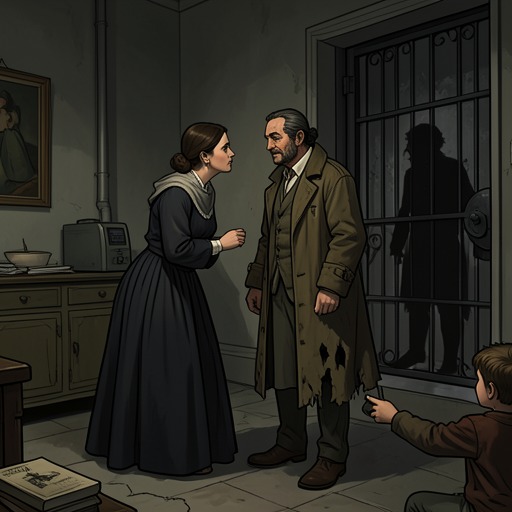
Andrevuola rejects the suggestion that Gabriotto’s body be left in the garden or abandoned to be found in the street. She wants his kinsfolk to have the chance to mourn him, rather than have him buried as though he were a dog. She spreads a piece of silk cloth on the ground, lays him on it with his head on a pillow, closes his eyes and mouth, and covers him with a chaplet of roses and the flowers they had gathered together. She and the maid set out to carry him to his house and place him before the door before daybreak. Before they leave, Andrevuola gives him the ring with which he had espoused her, calling it her last gift.
Officers of the provostry discover the women carrying the body and take them into custody. Andrevuola does not try to flee. She says she will explain the case before the Seignory, but warns the officers not to touch her or remove anything from the body. Physicians examine Gabriotto and find no evidence that he was poisoned or otherwise killed: an imposthume burst near his heart and suffocated him. His death is thereby established as a sudden natural cause, even as the secret circumstances of his marriage come under official scrutiny.
The provost attempts to use Andrevuola’s vulnerability to obtain sexual access, first offering release in exchange for her consent and then threatening force. Her refusal and resistance become part of the ordeal that follows Gabriotto’s death. Messer Negro arrives with friends, learns what has happened, and demands his daughter. The provost recounts his own conduct rather than risk her accusing him, and praises her constancy. Andrevuola then kneels before her father, asks pardon for having married without his knowledge, and asks to die as his daughter rather than as his enemy. Gabriotto’s story therefore ends, in the surviving account, with his widow’s public defense of their marriage and the immediate consequences of his death, not with a report of his burial.
Narrative Significance
Gabriotto’s role is brief but structurally decisive. The story sets two dreams beside each other: Andrevuola sees an unnamed dark force carry him away, while Gabriotto imagines a black hound tearing out his heart. His reasoning treats dreams as unreliable bodily accidents; the reader, given both visions before his collapse, sees how precisely their images converge on the loss that follows. The contrast is not evidence that he knowingly faces danger: he continues to trust the happiness of their meeting, while Andrevuola alone carries her fear into the garden.
His death also turns private love into a question of recognition and honor. Gabriotto cannot publicly protect the marriage he has made, but Andrevuola insists on naming him her husband, caring for his body, and returning him to his family with the ring that marks their union. The story’s attention to the cloth, pillow, roses, and ring makes mourning an act of care rather than a mere aftermath. Gabriotto is remembered not through a long record of deeds, but through the love he shares with Andrevuola and the choices his death compels her to make.